Showing posts with label climbing. Show all posts

Wednesday, 5 July 2017

Climbing Great Gully Ridge

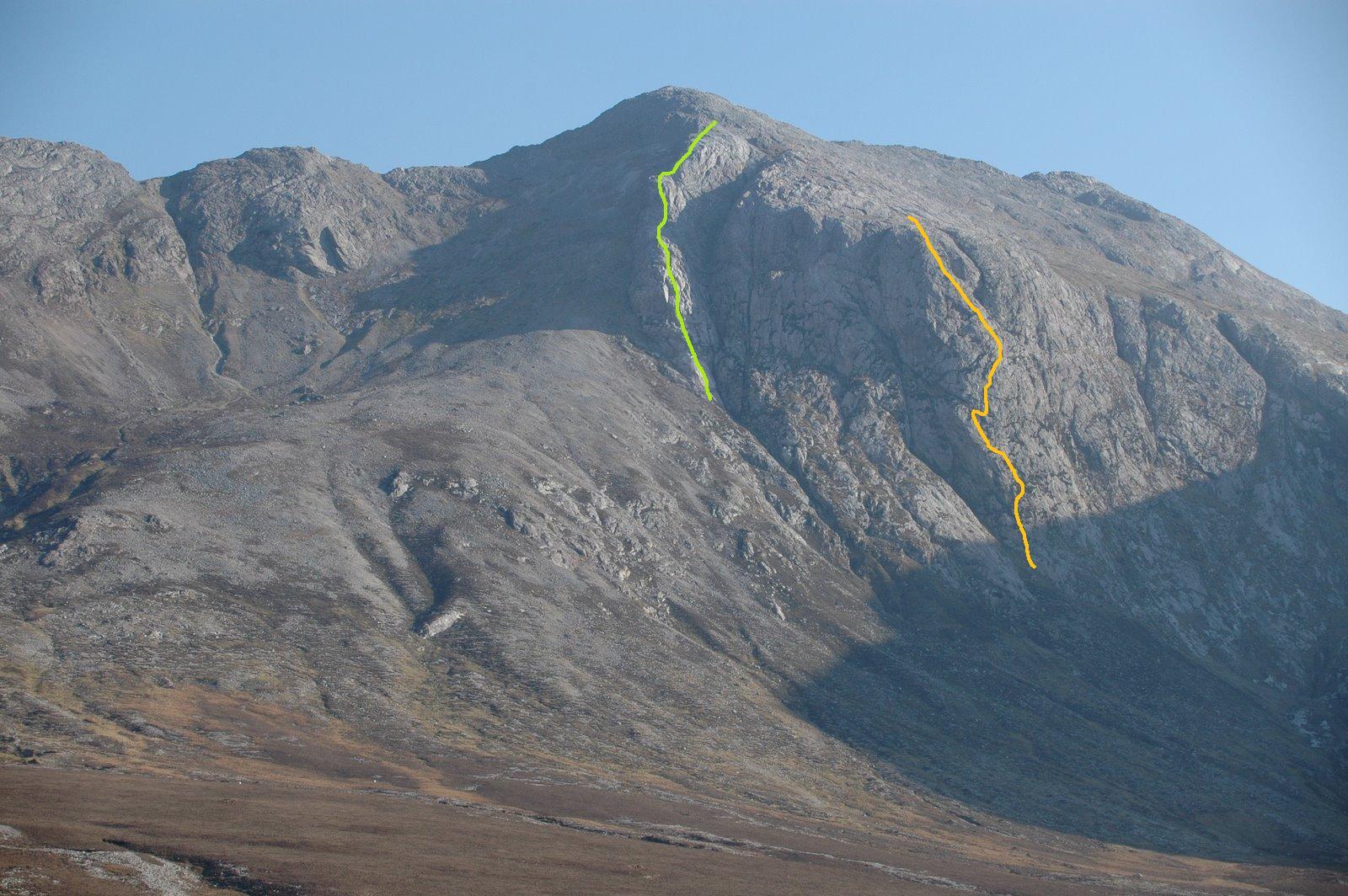
Great Gully Ridge on Ben Leagh from walk in
On the nasty gorse sinkhole walk out we bumped into a lad who asked what I did on the top pitch, did I do the crack with the piton? I described to him. gesturing with my hands, taking the first crack, getting in a good #3 nut, stepping up into this barn-door bridge-ish feet with my left-hand, bottom fingers turned sideways, slotted under a hidden crack and my right arm pulling on an edge, moving my left foot up a bit and then moving my left hand up expecting an edge but only finding slopers...not enough for me to hold and jump my right hand up...climbing as we know it!

A perfect day! The couple of mistakes I made were inconsequential in the end. The plan was to meet at the car park for Baravore Valley at 8.30. I had not organised buying an OS map for the area and had the WhatsApp directions from a friend in my head "turn right into Glenmalure having travelled down the Old Military Road from Laragh". I left 10 minutes later than planned and arrived in Laragh at 8.30, as I came in I saw a brown sign for the old military road kind of half going to the right outside the Glendalough Green cafe. I pulled up and asked the waitress, who was just starting to say "we don't have...", was that the Old Military Road, pointing to the right. She said "Yes, thanks a million", no doubt relieved I was not jonesing for coffee, as she gripped her first smoke.

So I headed up the road, passing the first big lay-by after a few minutes where there were some cars stationed and I could see tents in the trees. The road kept going and going, a couple of hikers, more campers, a cyclist - a perfect road for that. Another 10 minutes and there was a lad at the back of his car with the hatch up, I rolled up and popped the question. "You are on the wrong road mate, this goes to the Sally Gap, head back down to the crossroad, turn right back into Laragh, past Lynhams, then turn right and follow the Glenmalure sign". Military road my ass, 30 minutes lost.

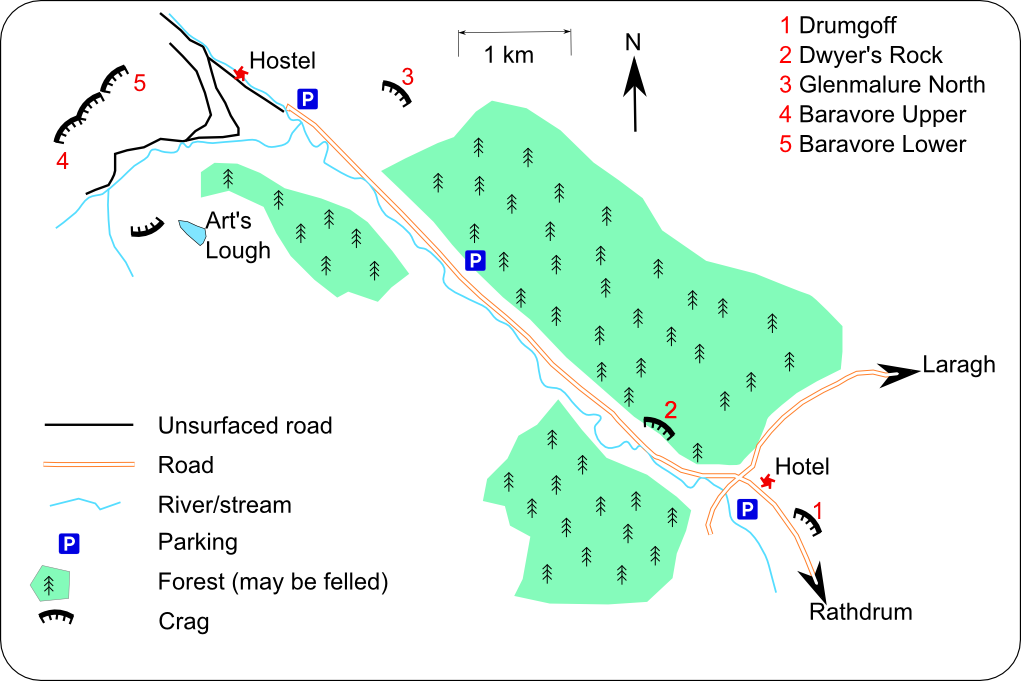
Glenmalure is a u-shaped glacial valley in the Wicklow Mountains in eastern Ireland, 250m higher than Glendalough, with this being the one road leading in or out, I turned right at the Drumgoff crossroads, with Glenmalure Lodge on the left, and took the road to the end where the Baravore Car Park was unexpectedly large. We left the car park at 9.40 having figured we walked up past the hostel. The warden was out in the garden and we queried about accessing Great Gully Ridge? "Keep on going, head up to the left, there are 2 lads ahead of ye", he called out, as we kept moving. This was useful when a couple of minutes later the road swung to the left with a path going on ahead.

So warm already, a guaranteed cracker of a day under the precious high-pressure spell. As we walked in the unsealed road into the heart of the Fraughan Rock Glen, another name for the valley, Colm told us about Michael Dwyer, who was a captain in the United Irishmen Rebellion of 1798. The area around us was a stronghold for rebels against the British due to its remoteness and inaccessibility but also relative closeness to Dublin. He held out for years in the hills with the British attempting to deny him shelter by severely punishing those suspected of harbouring his men. They assigned thousands of troops to Wicklow, and built a series of barracks as well as the aforementioned military road! Eventually, a deal was made but the British reneged on an agreement to give him safe passage to America and he spent 18 months in Kilmainham jail before he was sent to Australia as an unsentenced exile in 1805. However, he was stripped of his free settler status and transported to Van Diemen's Land (Tasmania). In 1808 the Governor of New South Wales ordered that Michael Dwyer's freedom was reinstated. Amazingly, Michael Dwyer was later to become Chief of Police (1813–1820) at Liverpool, New South Wales.

As the road progressed into the valley it became more and more obvious that our route was up in the right corner, a relief with the left side in shade somewhat. It's marked  Baravore Upper in the climbing.ie guide. As the unsealed road ended it was clear we need to cross the rough ground towards the base of the ridge, there was a slab with some water trickling down it that's better to cross lower than higher. We were at the base of the route at 11.00.


The route is HS, 4 pitches of 4a,3c,4b,4a and is described as 140m long on the climbing.ie route wiki. The system for grading traditionally protected climbs in Ireland is the traditional, two-part British \ Irish grade, a combination of the adjectival and technical grades. From the BMC site: "The adjectival grade [HS - Hard Severe] is the first part of the grade, and attempts to give a sense of the overall difficulty of a climb. This will be influenced by many aspects, including seriousness, sustaindness, technical difficulty, exposure, strenuousness, rock quality, and any other less tangible aspects which lend difficulty to a pitch. The second part of the grade, the technical grade [4a, 4b], is there to give an indication of the hardest move to be found on the route, irrespective of how many of them there might be, how strenuous it is, or how frightened you are when you do it." Comparing this to the USA where they have a single grade, the route is 5.6 from my experience.

David Flanagan's book Rock climbing in Ireland has a topo of the route and he has made these available: longer topocloser topo. We used the former for route finding:
Dave Flanagan's Topo
I lead all the pitches, bringing 2 ropes, with Colm coming second cleaning the gear and Dave following third bringing the backpack. We only used one of the ropes for leading\belaying. I did clip one or 2 pieces into the 2nd rope to protect Dave when there was some traversing and he was being belayed on that rope. I ran out the 2nd pitch but still needed a 3rd scrambling pitch to set up a belay at the grassy wall described for the last pitch.

Tom on 2nd pitch

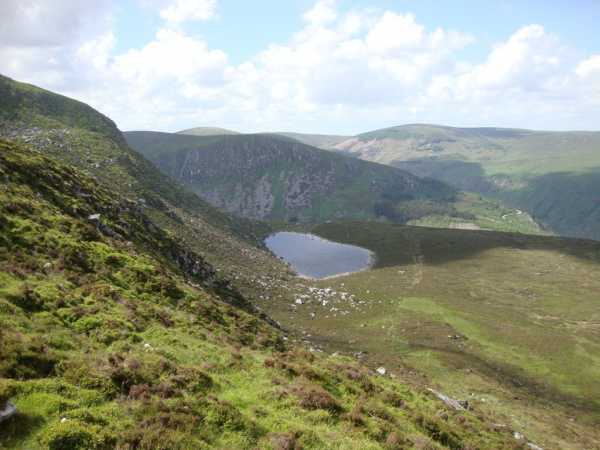
As we moved up the wall Art's Lough came more into view and the gorgeous weather made the thought of swimming across it all the more appealing.

Art's Lough from Great Gully Ridge
Taking snaps along the route got me thinking of a problem I never had climbing in the 90s and the first half of the naughties, what's a solution for carrying a camera phone when climbing? For multi-pitches, I used a small camera bag in the past clipped to my rack, but the camera always had a strap. Maybe a phone loop is an answer?

Dave & Colm on route
Dave Flanagan's 2012 blog on the route, describes three cruxes which are spot on, the first being literally at the start. I agree there is plenty of gear for all the cruxes. The exposure on the last pitch is outstanding and I wished it just kept going but it ended all too soon when another perfect belay spot materialised. There was about another 50m scramble up some grass, if you were to contine to the ridge top.

Colm found the abseil chain, I double-fishermaned the two ropes together and tossed them towards the narrow grassy gully. I ended up coming down a clean buttress, which must be the headwall area, it has a couple of 20m star VSs (D-for-Dog & Z-Backwards), which looked about right from abing down. The 50m rope barely got to the gully on the stretch. The orange rope would not pull! No tricks would get it loose. So it was out with my prusik to self-belay climbing up the corner. The 4 pm sun was catching us now and without a head scarf under my helmet, the sweat was literally streaming in rivers into my eyes, as I bridged up, with the sun block burning them as a result. I had to keep my eyes closed tight and trust those feet, feeling the prusik inching up. It's always great to have a reference and mine was The Maiden in Boulder's Flatirons in 1995 and having to "Kill the fear" and jumar with prusiks up a hanging free rope in the dark in order to free what ended up being a knot jammed on the other side of the lip. This time, it was easier, I reached a grassy bank and was able to traverse over to where I was above a point I passed between on the 2nd  pitch where I knew there was another abseil point. I figured the rope had to pull from there and it did with some effort.

Great Gully Ridge looking down route
So talking to the lad we met walking out, I pulled out of my climbing gestures and said, yep, I backed off and climbed the crack with the old piton in it! It was exposed but felt very solid in comparison to the first crack 😀 The lads said most people go that way! Reading the UK Climbing log, one climber says the first crack is a VS finish, which feels about right for my rusty climbing skills, a good edge for liebacking he says...hmmm, not sure about that part! This lad still had another 15 minutes slog to the base, he had two women with him and he was leading having done the route a few time before. He was going to walk down via the head of the glen near the watercourse. It was 6.30 and he had a solid 4 hours of light left, you can't beat Irish summer evenings!

We were out of water! Colm gave me the last 10ml when I got down after the abseil saga. I was well thirsty after all that! My reference was a summer day in Eldorado Canyon with Matt, perhaps my favourite crag to climb in the world, getting down and driving to a gas station and drinking a straight bottle of Gatorade! I think this was worse! On the ridge, we had spotted the 2 climbers ahead of us cutting directly from the base to the road and we followed suite. Clearly, there is no path through and with the vegetation at a mid-summer high, it was not possible to avoid sinkhole drops in the gorse. Not an escape to the road to remember, most definitely climb with all your gear and walk out via the watercourse after you top out on the ridge and walk down to where it drops into the valley. Next time I would also walk in the same way we did, taking the road to the end.

Gorse walk-out marked - it does not look so bad from a height!
We called into the hostel desperate for water - it's pretty much is a simple Mountain Hut, with no running water or electricity. We could hear the Avonbeg River flowing at the back of the hostel and see their stack of 5L Bottles in the kitchen. The volunteer wardens very kindly brought us out some glasses, I drank 5 straight. They told us the hostel is now open in the summer months and every weekend through the year, staffed by volunteers.

The hostel was originally built as a hunting lodge and key historical Irish figures have spent time there, Countess Markievicz, Maud Gonne and her son Sean McBride, a founding member of Amnesty International and Nobel Peace Prize winner. Of course, Maud Gonne was W.B. Yeats's Muse, so Yeats also visited. J.M Synge owned the estate at one point and he wrote a play which was set in the house. It also hosted Irish presidents Eamon De Valera and Erskine Childers. It was donated to An Oige in 1955. The climbers ahead of us had stayed at the hostel the night before, an ideal choice for getting a proper early start on the route.

The Glenmalure Lodge was a perfect stop before the 2-hour drive home and this was my order for myself! A new reference point for thirst!

Friday, 16 September 2016

Meacan Déarg

Carrot Ridge, Gleann Eighneach, Binn an Choire, Connemara,
370m Diff
Sunday 17 July 2016


So I picked up Matt at 8.30 in his hotel in Athlone, later than ideal but a good compromise with him just having arrived from Chicago the day before; we met Colm at 9.30 in Galway city. With a coffee stop and finding literally the only parking spot on the Recess Kylemore road we left the car at 11.30. We hiked in via sheep trails, following the river into Gleann Eighneach, having to cross this before hiking up to the hidden base of Carrot Ridge - a tough ascent carrying packs.

Matt insisted on hiking in flip flops (one of his trade marks) and one strap spit before reaching the base with him finishing in bare feet. I got a big shock when i opened my bag and found no climbing shoes, seeing them in my head in the side pocket of my climbing gear bag in my room where I swapped bags to a 45L :-(


We started up the route at 1.30 carrying 2 packs and with me and Matt swapping leads, Colm was in the middle tied into a 60m and 50m to Matt and myself respectively. The grade was run out Diff (5.3, maybe some 5.4) and I managed to lead fine in boots.

We had the whole valley to ourselves, it was incredibly peacefully up there with a distant sound of the river Inagh and the endless sheep. We ate lunch on a wonderful ledge up at the top of pitch 6 before the rain came in. We couldn't see the road or any signs of civilisation, proper remote, I haven't experienced much if any of that in Ireland.

The climb was 370m, climbing,ie says, on lovely quartzite and after 8 pitches the last 100m was a gorgeous 100m clean rock scramble. It's so special being high on rock after a step hike into the base. On the route there was an amazing view of Seventh Heaven (HS) to the west against the skyline (see this topo), a 8 pitch route with plenty of 30m 4b run out I'm told. I'll be dreaming about it!

We topped out at 5.30 with the last hour-ish in rain, the rain, which had finally blown in from the west, was not too bad and didn't ruin things. Then we had a nasty descent down a scree slope \ moving boulders. Matt hiked down in his climbing shoes down to the flat before switching to the ripped flip flop. With a bum knee flaring up for Matt it was close to 8 by the time we were all back to the car. Epic. Great to be alive.

Named Meacan Buí, Colm's brother, who lives in the Gaeltacht, told him that means parsnip and it should have been called Meacan Déarg!
I highly recommend this amazing mountain experience at our doorstep here in Ireland.

Friday, 11 December 2015

Lynam Lecture & Medal 2015 - Ines Papert


Last night at the Edmund Burke Lecture theatre in Trinity College Dublin, Ines Papert got presented with the Joss Lynam Medal for 2015 by the Mountaineering council of Ireland, see their review of the night.


The Lynam medal was first awarded in 2011 and here is the complete lst of winners.

Ines Papert's account of her first ascent completed on Mount Asgard in Baffin Island was fascinating and included a 60k walk-in with intense river crossings.


She got into paragliding as she hates walking down. An excellent multimedia presentation. Gift.

Wednesday, 3 July 2013

Ancient Brambles arĂȘte & the lost ring

Rock Climbing is my favourite thing to do in the outdoors, the places it brings you, the freedom, the feeling of satisfaction are not really paralleled for me.
In 2009 I took a breath and realised I had not been on the rock since Easter 2006 when I spent an amazing five days at Pedraforca in the Pyrennes (including a benighting after climbing the stunning line circled in the picture).

Living in Waterford and hiking up to the amazing Coumshingaun I had been wanting to get up there climbing. I had a Saturday outing with Cormac in July to the excellent Ballykeefe Quarry in Kilkenny and then on a September Sunday I went up to the coum with Andy, where we fought through the typical rain and got up a 25m route on the south-facing cliff - Devices & Desires (HS 4B). Too many plans foiled by the weather, too little time.

Martin and I started hatching plans for Costa Blanca and that November we spent 3 prime days climbing there (including Penon d'Ifach pictured below).

I had not been on the rock since, going on 4 years. Over the June bank holiday weekend I brought my 6 year old on the climbing wall in Dingle, she flew up the 20m walls and loved it. Then I read McG's post about midweek night summer rides and I got inspired.

I started climbing outdoors through a beginner's climbing course in Dalkey quarry with the Irish 
Mountaineering Club in spring/summer 1992. On that course I made a lad, Colm, and we purchased a rope and basic rack together. 2 years later I moved to the USA, before going we split the gear, buying a 2nd rope which Colm kept, with me retaining the original. I climbed all over with this rope until I dislodged a rock at Ti Point in New Zealand in 2000 which ended up badly damaging the rope at the half way point and ending up with 2 25m ropes. I still have the damaged piece:


Colm and I had briefly got back in touch last year over a phone call but I had not seen him in a long time. I got on climbing.ie which hosts a wiki for climbing in Ireland and I saw 2 small crags in Westmeath both near Castlepollard. With me in Athlone and Colm in Dublin I proposed we meet up at one, the Rock of Curry, and go climbing.

We arranged to meet up the evening of Wednesday 19 June which turned out to be a lovely evening. We eventually both found the little farmers lane described on the wiki at about 7.30. The crag looked impressive, especially for the Midlands, perched up there from the road and we started catching up on nearly 20 years as we got organised.


We could hear farm equipment on the go and we kept an eye out for the farmer to have a chat. It was not long before he came up to us, he was a nice lad but unfortunately there was no way we could climb there he said. I showed him the details of the crag on the web and he was unaware of previous climbing done there in 2010 & 2011. His stance was that with the crag and access being on his land, one sue would shut him down.

It's an unfortunate situation in Ireland where there are almost no public right of ways at all. I got the farmers details and have since talked to the Mountaineering council of Ireland's Access officer who is going to contact him and expects to put him at ease. So I hope to get back to the Rock of Curry this summer!

I remembered the 2nd crag in Westmeath and getting connectivity back in Castlepollard we found the crag was close by in Fore. The small outcrop is unmissable from the town being a 5min walk up behind the graveyard. In the summer evening light the gorgeous view from the base of the crag of the valley overlooked the old Benedictine Abbey ruin of Fore Abbey where St FeichĂ­n founded an Early Christian monastery around 630 AD.


Colm had brought his rope, it turns out it was the 2nd rope we had bought in 1994, which I had never climbed on, tonight was to be the first time. The climbing wiki describes 3 routes on the rock the first put up in 1974. It must have been after 9 when I tied in and started up this route in the middle of the buttress. Starting to climb, I noticed my ring and down climbed tossing it into the side pocket of my bag. The rock was solid but had some loose bits due to not being climbed on frequently. There was an obvious crux (hard bit of the climb) which I worked on for a while, on stepping up over the bulge it felt a bit loose and taking account of the time of the day and wanting to get something done I backed off.

Really I fancied the small arĂȘte 5 metres to the right which was unclimbed! I have only put up one route before, on the North Island in New Zealand, a chimney I christened Buzzing Web. This was a not so difficult climb but it felt great to be on the rock again. As I climbed the arĂȘte the vertical ridge became more obvious and would look more aesthetic if some gardening was done to remove the vegetation.


With the fine evening we were in shorts and getting to the top of the pillar it became obvious pretty quickly when I tried to go further that I was being ripped to shreds. With the night drawing in I decided to setup a belay station which we could abseil from slinging the pillar with a 5m corlette.

When I got home I added the climb to the wiki and called it Ancient brambles arĂȘte. The following day I missed my ring and that night went through my bag - absolutely gutted to not find it. Christine had given me this ring when we got married at sunset on a boat in Hawaii, this was not cool. Colm checked and it was not in his bag. I could not believe I had not hung it on some gear and just tossed it in the bag loosely and absent-mindedly. I took a half day on Friday and rented a metal detector and went back to Fore with all the family where we diligently spent 2 hours finding and digging up old beer cans and the like. We came to the conclusion that a cow had eaten it in the grass. When I found a story about a wedding ring being found in a cow when it was cut up 3 years after being sucked off the finger I was not too hopeful. We talked about heading back with a couple of detectors checking all the patties. Also, Christine since rang the garda station and tourist office.
You can see the detecting going on in the picture!

Last night I finally got to reorganising my gear nearly 2 weeks after the climb at Fore.

Sorting my second last piece, I was blown away so see sitting on the carabiner on one of the extenders my ring! Subconsciously old habits died hard and I must have slipped the ring on a carabiner when throwing it into the bag without even realising it.

Friday, 23 October 2009

The sky walker


I've known about Dean Potter as an unreal solo climber and one of the last standing it seems with legends dying off.

  • Derek Hersey, a legend in Boulder, died in 1993, getting caught in a flash rain storm soling on El Cap.

  • Todd Skinner died in Yosemite in 2006 when the belay loop on his harness failed.

  • Michael Reardon was washed away by a rogues wave in Valentia, Co. Kerry in 2007
  • This year one of the alltime legends, John Bachar, died soloing in California at the age of 52.


I heard about a current Channel 4 series, Daredevils this week and last night watched "Sky Walker" online, the episode on Dean Potter Slacklining - walking across a tightrope with no pole or safety line at huge heights.

Sky Walker and other episodes can be watched for another 11 days online with Channel4 on demand available to watch in Ireland.
Subscribe via FeedBurner